Breaking through the Slowdown: How Smart CPOs PREPARE for the EV market rebound
A year ago, we wrote about how Charge Point Operators (CPOs) could navigate the EV market’s stress test. Interest rates were elevated. Capital was expensive. Sales growth had slowed. The question many were asking: should we pull back or push forward?
Today, while challenges remain, European markets are showing clear signs of renewed momentum.
The fundamentals we outlined a year ago remain relevant. But the time to prepare for recovery is narrowing.
This article revisits the key market dynamics, consumer concerns, and strategic actions necessary for preparing your business for the inevitable rebound in demand.
What’s at stake?
Elevated interest rates, financing costs, and regulatory volatility across Europe slowed electric vehicle (EV) sales growth over the past three years and challenged business cases. For many Charge Point Operators (CPOs), EV sales volumes are central to long-term viability, and this period directly tested delivery commitments and investment plans.
As a result, many operators chose to wait, preserve capital, and reduce risk. That caution was understandable. Some CPO owners reacted even much stronger than this.
However, CPOs that treated the slowdown as something to simply “sit through”, or that questioned the market fundamentals and reacted with drastic measures, risk being caught unprepared as momentum returns. In the worst case, they may lose opportunities or jeopardize investments. Those who used this period to strengthen their business are better positioned to lead.
The difference between these outcomes will be defined by what you have done during the slowdown — and especially by what you do in the next 12-18 months.
what the market is telling us
The fundamentals haven’t changed: climate change continues to accelerate, and with transportation contributing roughly 25% to global CO2 emissions, electrification remains one of the most direct and effective ways to mitigate negative climate impact.
Mobility is a basic need, and cars need to be renewed. Failing to do so leads to declining value and convenience, rising costs, and missed emission targets.
While financial concerns have delayed consumer decisions, they have not removed demand.
Instead, this has created a “renewal debt” — pent-up demand that tends to be released more rapidly once conditions improve, often referred to as the “ketchup-bottle effect.”
Recent market signals suggest the tide is turning. Interest rates have dropped. Demand is picking up in parts of Europe, even if unevenly across regions and segments. The share of BEVs of total sales is continuously increasing, even during the slowdown and including fully electric cars surpassing petrol cars in EU monthly sales in December 2025.
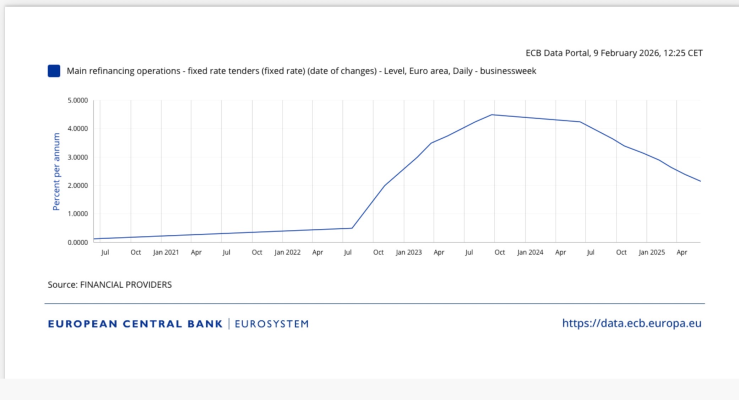
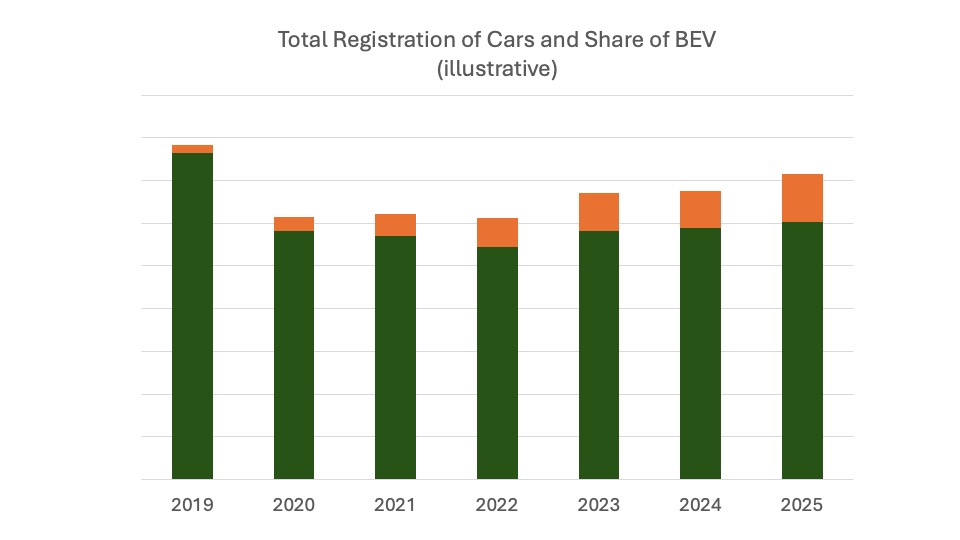
What this means for CPOs: the slowdown was not demand destruction. It was demand delay. The infrastructure you build today won’t face immediate capacity constraints, but it will be stress-tested as momentum accelerates. Are you ready for that moment?
Building Trust: The Key Consumer Concerns
The primary concerns preventing consumers from choosing EVs are:
- Perceived high cost of ownership
- Range anxiety
- Lack of abundant and reliable charging infrastructure
These concerns, especially the third, must be addressed by CPOs. Building trust in the charging network remains critical in converting delayed demand into actual adoption and building consumer confidence in EVs. There is still much to be done as data we analyzed shows: Public User Ratings for European charging locations have dropped from 4.03 in 2020 to 3.5 in 2025. While “crossing the chasm” — the shift from early adopters to the early majority — explains part of this decline, substantial improvement efforts are still required from CPOs.
What comes to the other concerns, especially the range anxiety, the situation is improving. In one of my latest LinkedIn posts, I shared my takeaways from a Helsingin Sanomat article about the FLTP 1000 winter test, during which 66 EVs drove 1000km at -15 to -30°C and Mercedes-Benz AG set a new benchmark with their new EQ CLA.
How to Prepare for the Rebound: Strategic Priorities
Here’s what you can do:
1. Build for Scalable Growth
We are still in the early stages of EV adoption. Only a small percentage of the global fleet is electrified, and this remains true for many European markets. The long-term opportunity hasn’t changed.
What has changed is timing. The slowdown tempted many to pause. But the larger picture remains unchanged: the fight against climate change continues, and electric drivetrains remain the most credible large-scale solution for decarbonizing road transport.
With demand showing early signs of strengthening, the question isn’t whether to build. It’s how to build smart, and how quickly you can scale when the market fully rebounds.

2. Know Your Market Position – Through Benchmarking
How do you compare to your peers when it comes to key business parameters, like financial health, operational excellence, customer satisfaction, business sustainability, and rollout efficiency? Understanding your performance relative to the market is essential.
“We’re improving” means nothing without context. The critical questions are: How does your uptime compare to top-quartile operators? What’s your cost per kWh delivered vs. market average? Where does your customer satisfaction rank? How efficient is your site deployment compared to peers?
Reliable KPI benchmarking turns uncertainty into direction. It shows where to fix weaknesses, where to double down, and where to invest with confidence.
Action steps:
- Establish clear performance benchmarks against comparable operators
- Identify your top 3 performance gaps
- Set measurable, realistic development targets and track your progress
- Communicate your validated achievements effectively to investors and partners
In a capital constrained environment, even as it begins to ease, investors aren’t funding potential. They are funding demonstrated performance. Benchmarking gives you the evidence.
3. Maintain Financial Discipline
The infrastructure you’ve built and the customers you’ve acquired need to be based on solid financial principles. If your core operations are financially sound, you’ll have the flexibility to reduce investment in growth when necessary and still maintain a stable, possibly even profitable, business. This will also put you in a strong position to make strategic decisions: whether to consider selling, to attract new capital, or to accelerate growth as the market recovers.
Financial health isn’t about surviving the slowdown. It’s about having choices as momentum returns. And we’re witnessing that moment now.
What‘s Your Next Move?
Ultimately, this past period has tested business fundamentals. The recovery will reward those who strengthened them during the slowdown. So ask yourself:
- Do you now where you truly stand vs. the market?
- Can you demonstrate operational excellence to investors?
- Are you building competitive advantage—or just holding on?
If you’re ready to answer these questions with data rather than assumptions, reach out and let’s talk!
*Sources:
Reuters, January 2026 – “Electric car sales edge above petrol in EU for first time”
ACEA, January 2026 – “New car registrations: +1.8% in 2025; battery-electric 17.4% market share”